
Thoughts on Silicon Valley and Moving to Minicrypt
Co-authored by Gentry Demchak and ChatGPT.
I finally finished the last season of Silicon Valley. I am late to the party, but with everything happening in AI and Bitcoin, the ending landed differently than it would have a few years ago.
Spoilers for the series finale ahead.
Richard decides to sabotage Pied Piper’s launch after realizing that its technology can break the encryption protecting the digital world. The same breakthrough that promises extraordinary scientific progress threatens everyone’s privacy.
It made me wonder what an actual AI lab would do in that position. Would it destroy its own breakthrough? Delay release? Inform governments? Or forge ahead because the potential benefits were too large to abandon?
My suspicion is that competitive pressure would make stopping extremely difficult. That is a judgment about incentives, not evidence that any lab has broken encryption. Still, the show left me with a question I could not shake: what would society look like if strangers could no longer establish a private connection over the open internet?
That question sent me down a rabbit hole with Gemini. This essay develops my original post on X, with a clearer separation between cryptographic facts and the futures I am imagining.
The seven illustrations came out of that exploration. They are AI-generated thought experiments, not protocol specifications. Some embedded labels simplify the cryptography or make stronger predictions than the evidence supports; the text explains those limits.
Five possible worlds
Russell Impagliazzo’s five worlds provide a useful vocabulary for thinking about what kinds of cryptography might be possible under different computational assumptions.
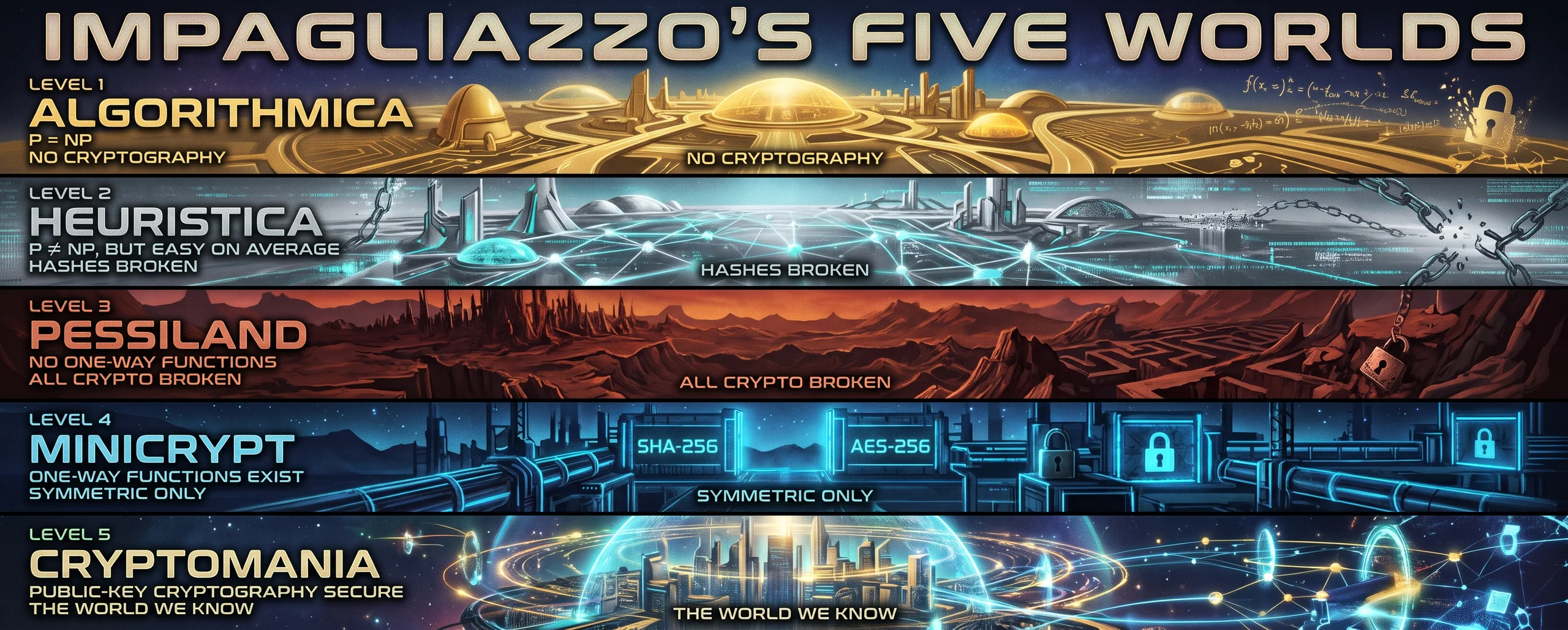
| World | The central idea | Consequence for cryptography |
|---|---|---|
| Algorithmica | P = NP: efficiently checking a solution also leads to efficient algorithms for finding solutions. | Conventional computational cryptography loses its foundation. |
| Heuristica | Hard problems exist in the worst case, but efficiently sampled instances are easy on average. | Worst-case difficulty does not provide the average-case hardness cryptography needs. |
| Pessiland | Average-case hard problems exist, but one-way functions do not. | Hard problems remain without the one-way functions needed for conventional cryptography. |
| Minicrypt | One-way functions exist, but secure public-key encryption does not. | Symmetric encryption and digital signatures can exist, while open public-key encryption is unavailable. |
| Cryptomania | Public-key encryption is possible. | Parties can establish confidentiality without first sharing a secret. |
These are possible mathematical worlds, not stages on a technology roadmap. We use systems believed to give us the capabilities of Cryptomania; we have not proved the assumptions underneath them. MIT’s key-agreement lecture notes explain the crucial distinction: one-way functions can support signatures without giving us public-key encryption.
That distinction matters throughout this essay. A signature lets other people verify that you authorized a message. Encryption keeps the contents secret. Both may involve public and private keys, but losing public-key encryption does not mean losing every possible signature scheme.
For the rest of this thought experiment, I am assuming something stronger than a break of RSA or elliptic curves: practical public-key encryption and open key agreement are unavailable, while suitable symmetric encryption and hash-based constructions remain secure.
Breaking an algorithm is different from entering Minicrypt
An attack on today’s popular algorithms would not establish that public-key encryption is impossible. A sufficiently capable quantum computer could threaten existing systems while alternatives remain viable. NIST has already standardized ML-KEM, a post-quantum mechanism for establishing shared secrets.
AI discovering a cryptanalytic shortcut would also be different from proving P = NP. And even a mathematical breakthrough would still need to be assessed for its practical running time and the systems it actually affects.
Preparation for post-quantum cryptography makes the possibility feel tangible, but it does not prove that Minicrypt is inevitable. The scenario interests me because it asks what happens if replacing one algorithm with another stops being enough.
The immediate risk would be severe. Where an attacker could recover session secrets, recorded traffic could become readable. Where an attacker could forge authentication, it could impersonate services or users. The damage would depend on each protocol and its assumptions; breaking encryption would not automatically grant remote code execution on every connected device.
The comparison that came to mind was Y2K, with an uncomfortable difference: a cryptanalytic breakthrough might arrive without a public countdown. The discovery, its disclosure, and its widespread exploitation could happen at very different times.
Private communication survives. Establishing trust gets harder.
Symmetric encryption still works in the scenario I am considering. If two people already share a strong secret, they can use it to protect their communication.
The hard part is getting that secret to them in the first place.
Today, public-key techniques let a browser and a previously unknown server establish a protected connection, with authentication supplied by the surrounding system. Without secure open key agreement, a connection needs another starting point: prior secrets, physical provisioning, an existing protected channel, or trusted intermediaries.
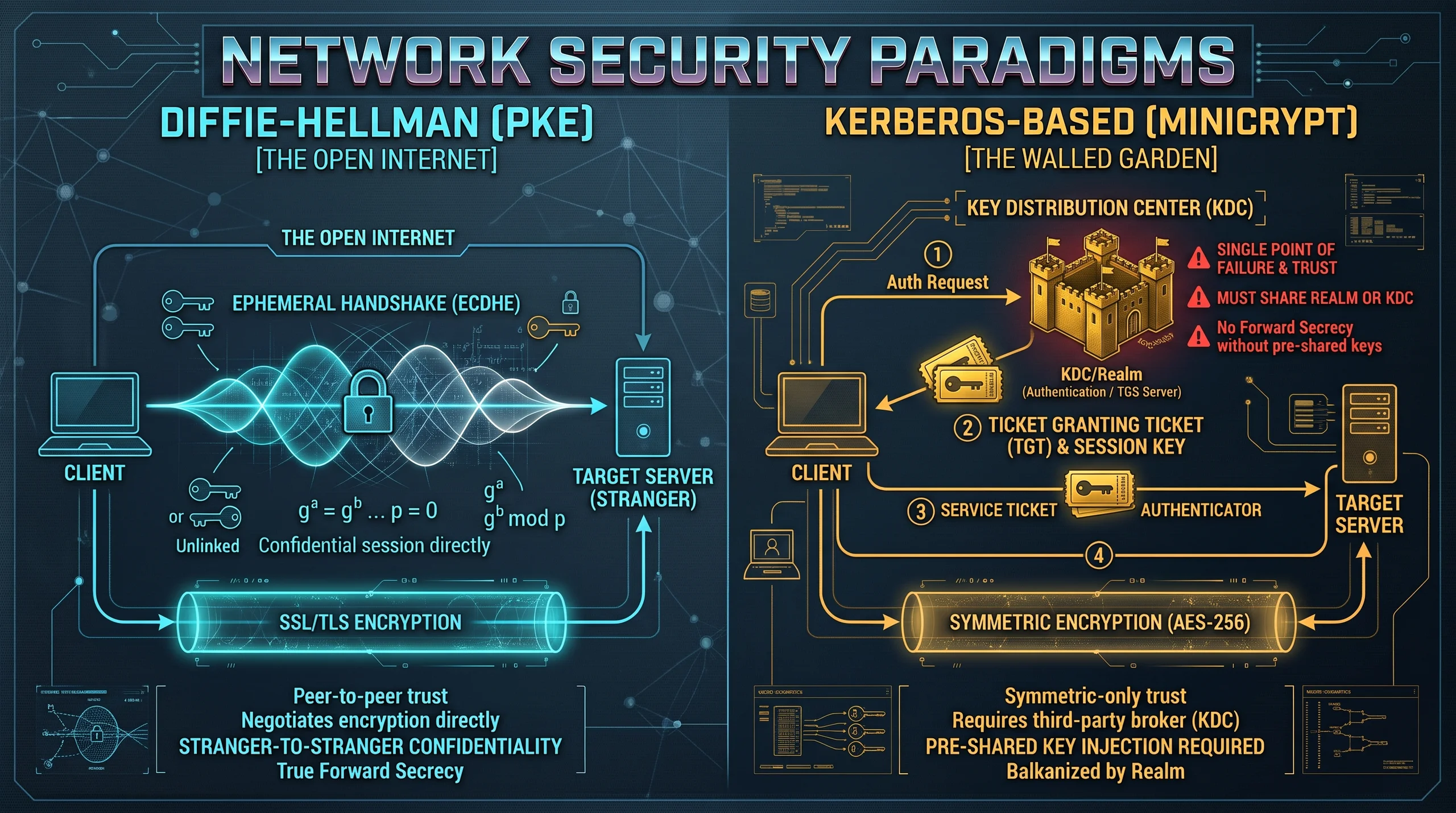
Kerberos is one example of brokered trust. Clients and services share long-term secrets with a Key Distribution Center, or KDC, which issues tickets and session keys. The Kerberos specification also describes cooperation between separate realms; everyone does not have to use one global KDC.
There is even an older specification for Kerberos cipher suites in TLS. Modern TLS 1.3 supports pre-shared-key-only establishment, too. Neither fact makes today’s web automatically ready for this future: provisioning secrets, supporting browsers, recovering accounts, and connecting independent organizations would still be enormous problems.
A manufacturer could provision a device with secrets. A community could exchange them in person. Institutions could negotiate trusted links. Each arrangement moves part of the security problem into a physical or organizational relationship.
That is the tradeoff that caught my attention. We could preserve encrypted communication while becoming much more dependent on whoever introduces us.
Who holds the keys?
A KDC is useful precisely because it occupies a privileged position. Compromise it, and an attacker can impersonate participants and undermine the sessions it brokers. The Kerberos specification explicitly treats KDC security as fundamental to the realm’s security.
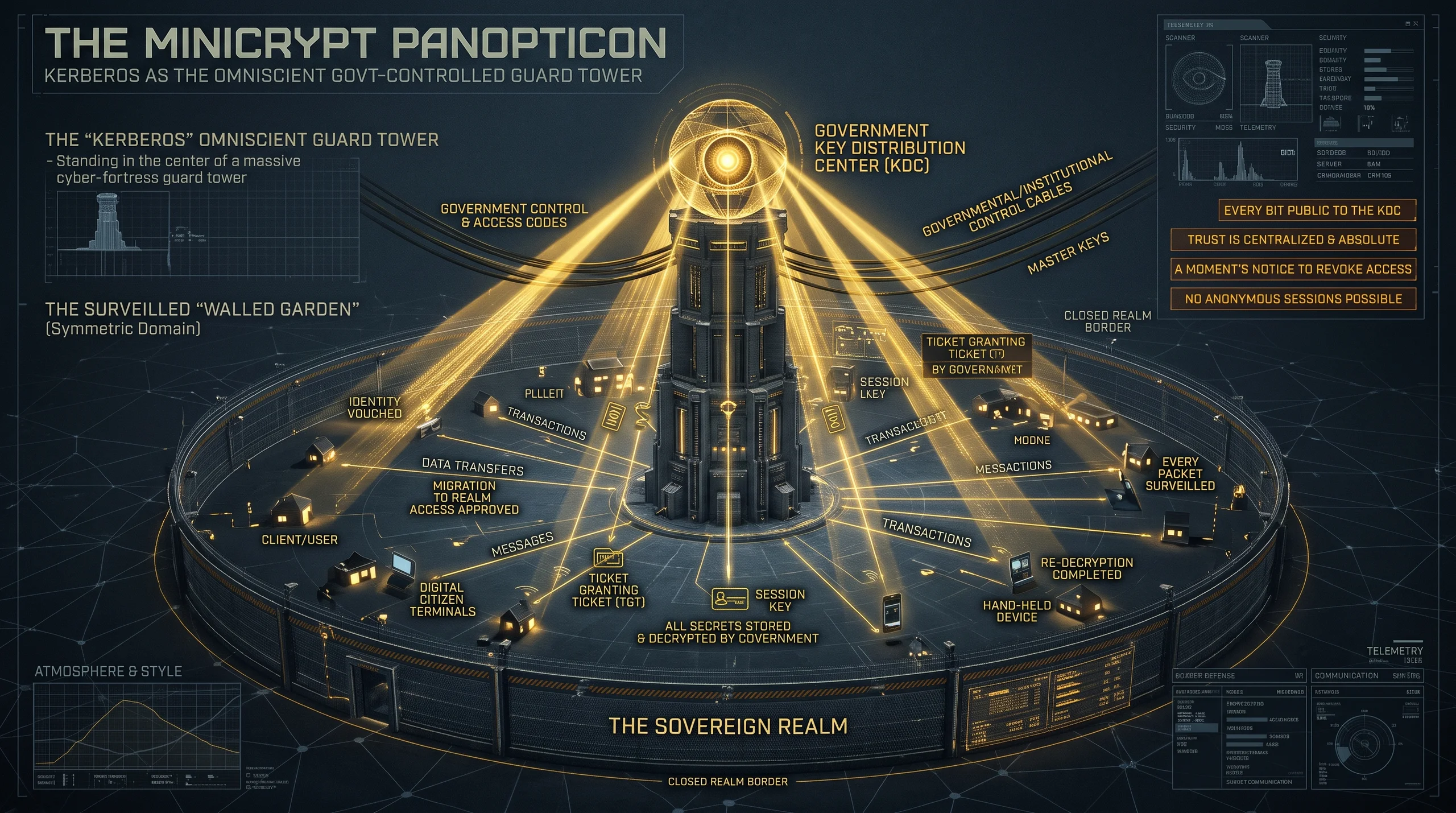
The panopticon image expresses my concern about where that power could end up. A government or dominant platform controlling the relevant infrastructure could gain substantial power over access, identity, and observation.
But a government-run master key for every person is a political outcome, not a mathematical requirement. Multiple providers, independent communities, and direct secret exchange remain imaginable. Nor does using a KDC imply that its operator can read every separately protected bit of information.
My worry is that the alternatives would be inconvenient enough that most people would use the default. If private communication required special hardware, physical meetings, or membership in a trusted community, privacy would become harder to obtain and sustain.
That could change anonymous speech as much as it changes shopping or banking. A network might remain technically secure while making permission to participate much easier to withdraw.
What happens when sovereigns do not trust each other?
Now extend that problem to international trade.
Would two rival governments accept infrastructure that gave the other side control over their access? Would they trust its key provisioning, administrators, or recovery process? Even allies might want independent systems when the consequences of exclusion were large enough.
My hypothesis is that losing easy open key agreement would increase the pressure toward separate trust domains. Cross-border communication and payments could depend more heavily on negotiated intermediaries and prearranged relationships.
Those domains would not have to become disconnected national intranets. Cross-realm agreements could bridge them. But every bridge would raise an institutional question: who can revoke access, and what happens when the relationship breaks down?
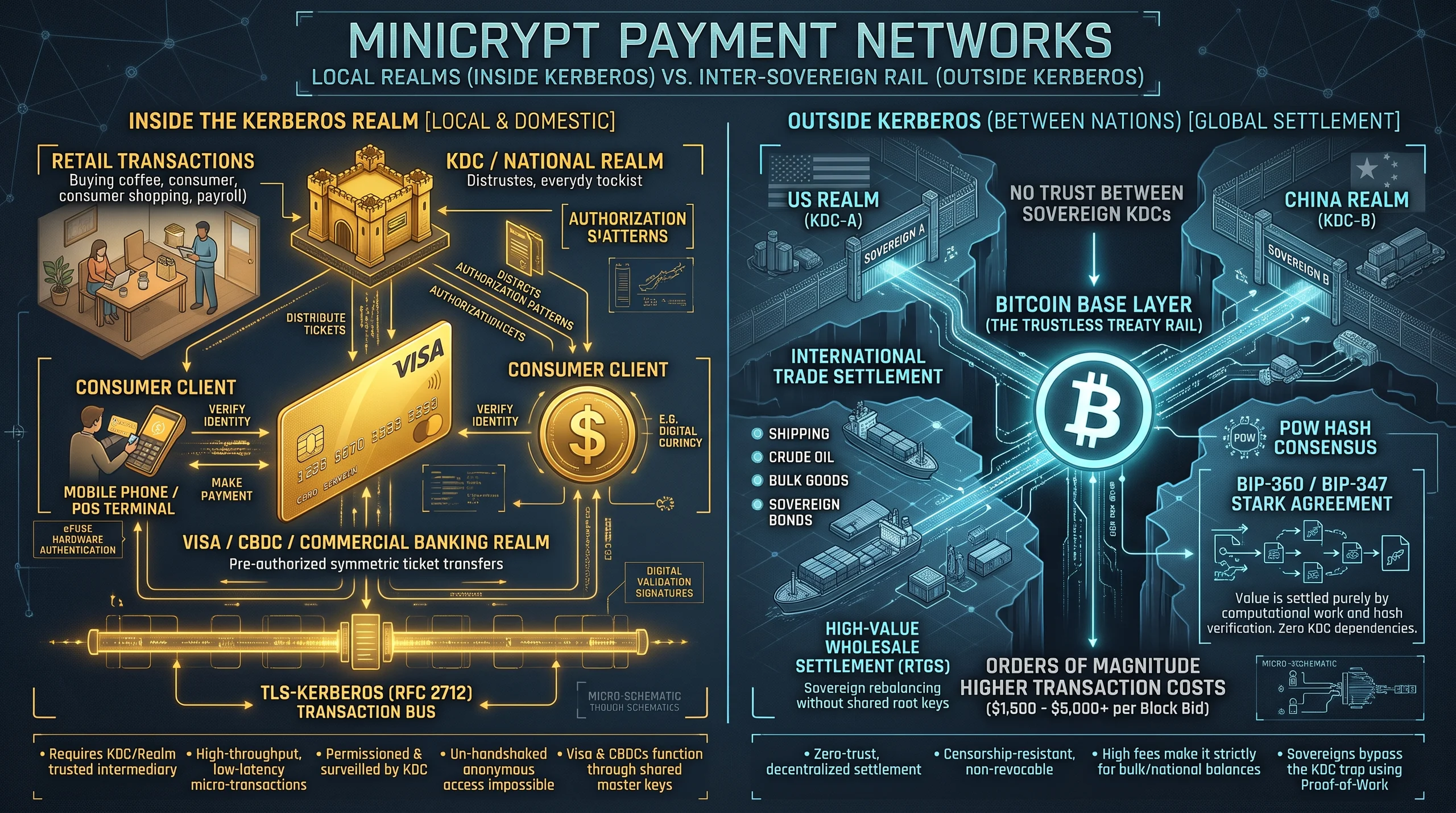
This is where Bitcoin became interesting to me. A neutral ledger could be valuable to parties that need to settle obligations without giving either side exclusive control of the system.
That does not make Bitcoin the automatic winner. Price volatility, liquidity, custody, regulation, connectivity, and consensus security would still matter. My narrower claim is that neutral settlement could become more attractive as bilateral trust becomes more expensive.
Bitcoin would need its own transition
Bitcoin transactions are generally public already. Their security problem in this scenario is authorization: an attacker who can defeat the relevant signature scheme may be able to spend someone else’s coins.
Hash-based signatures offer a different foundation. NIST’s SLH-DSA standard, based on SPHINCS+, is a concrete example of a signature scheme built around hashes. A surviving signature system could preserve public verification without restoring public-key encryption.
Two Bitcoin proposals came up repeatedly during my exploration:
- BIP 347, OP_CAT, proposes a concatenation operation in Tapscript. Its motivation includes constructing hash-based Lamport signatures.
- BIP 360, Pay-to-Merkle-Root, proposes removing Taproot’s key-path spend. It explicitly distinguishes long-exposure protection from the additional work needed to protect keys revealed while a transaction awaits confirmation.
These are pieces of a possible path, not a complete Minicrypt-ready Bitcoin protocol. Publication of a BIP does not establish network activation. Signature verification rules, wallet support, migration of existing coins, and consensus would all need to be addressed.
I find that engineering problem compelling: preserve public verification and open participation while replacing the assumptions that make current spending authorization possible.
The cost of keeping settlement open
The original exploration included Gemini-generated estimates of transaction sizes, fees, and miner revenue. Those tables were useful prompts, but precise future fee forecasts would imply more certainty than I have.
There is a real size tradeoff. BIP 340 Schnorr signatures are 64 bytes. NIST’s SLH-DSA parameter table includes signatures from 7,856 to 49,856 bytes. Those are signature sizes, not complete Bitcoin transactions, and they do not describe every possible hash-based approach.
| Design choice | Potential benefit | Cost to investigate |
|---|---|---|
| Individual hash-based signatures | Publicly verifiable authorization using different assumptions | Larger witnesses and verification work |
| Stateful signing schemes | Potentially smaller signatures | Safe state management, backups, and recovery |
| Aggregated proofs | Spread proof overhead across many transactions | Coordination, proof generation, latency, and verification rules |
If a transition made blockspace substantially more expensive, a high-value settlement role might become more attractive relative to everyday payments. That is a conditional economic argument, not a prediction that Visa must handle coffee while Bitcoin must handle sovereign trade.
The same caution applies to Bitcoin’s long-term security budget. For a simple illustration, suppose a block contained 100 fee-paying transactions:
| Assumed average fee | Fee revenue per block | Annualized fee revenue at 144 blocks/day |
|---|---|---|
| $1,000 | $100,000 | $5.256 billion |
| $2,500 | $250,000 | $13.140 billion |
| $5,000 | $500,000 | $26.280 billion |
This is arithmetic under stated assumptions, excluding the subsidy, not a demand forecast. Bitcoin fees purchase blockspace; they are not automatically a percentage of the value settled. Moving more trade onto the network would not by itself produce any of these revenue levels or resolve every security-budget concern.
Would the tradeoff be worth it?
I also asked Gemini to imagine the benefits of a world organized around stronger hardware trust and explicit identity.
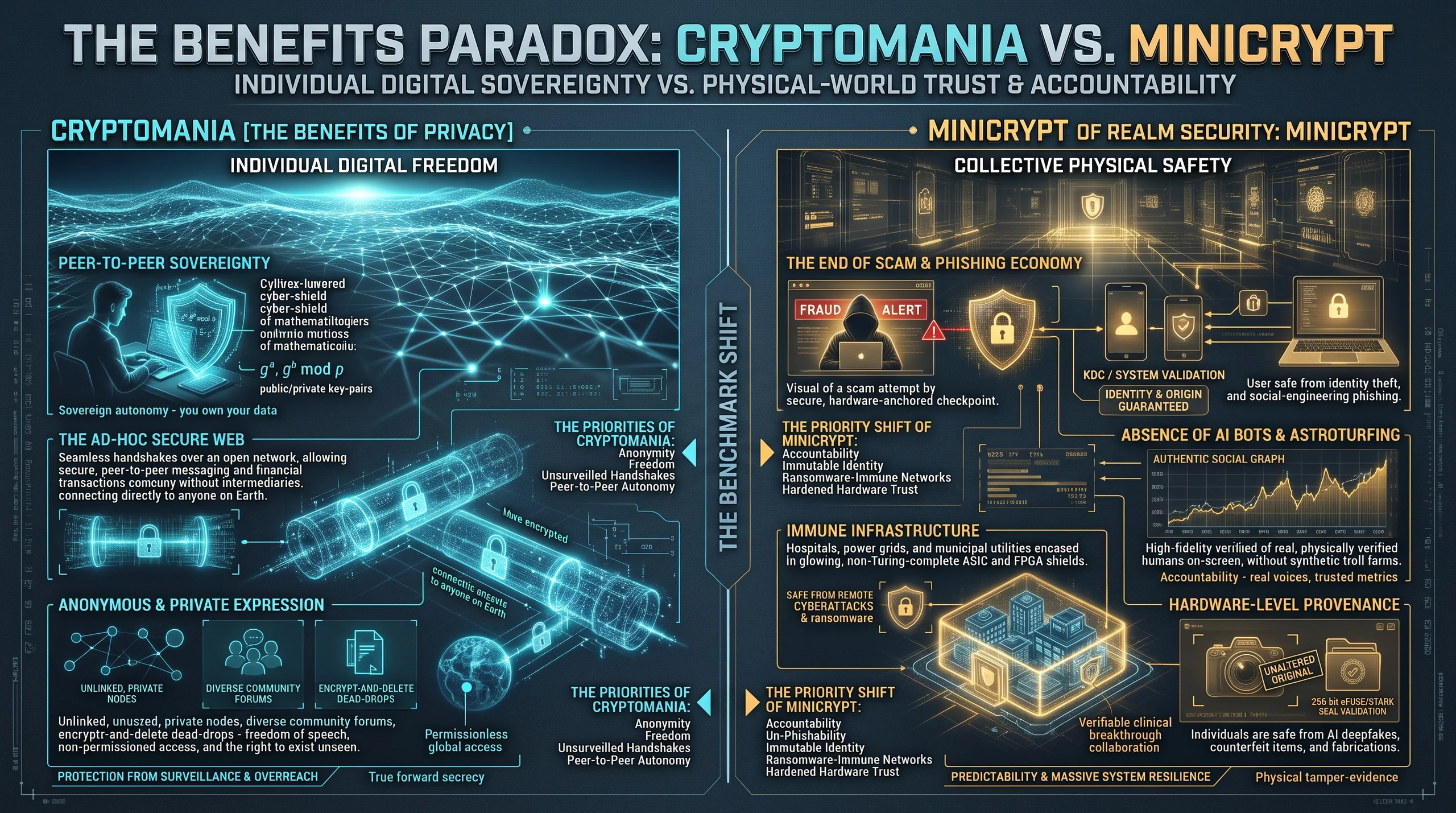
The optimistic version includes better provenance, more accountable institutions, and infrastructure designed around smaller, more controlled interfaces. But hardware authentication does not eliminate social engineering, and removing general-purpose computation does not guarantee a system is free of exploitable flaws.
More fundamentally, losing public-key encryption does not itself unlock better medicine, safer infrastructure, or more trustworthy data. The fictional breakthrough in Silicon Valley bundles enormous capabilities together. Reality does not owe us that bargain.
The final two images are speculative technology trees from that exercise. I like them as a way to explore dependencies and possible institutions, rather than as predictions of what cryptography forces us to build.
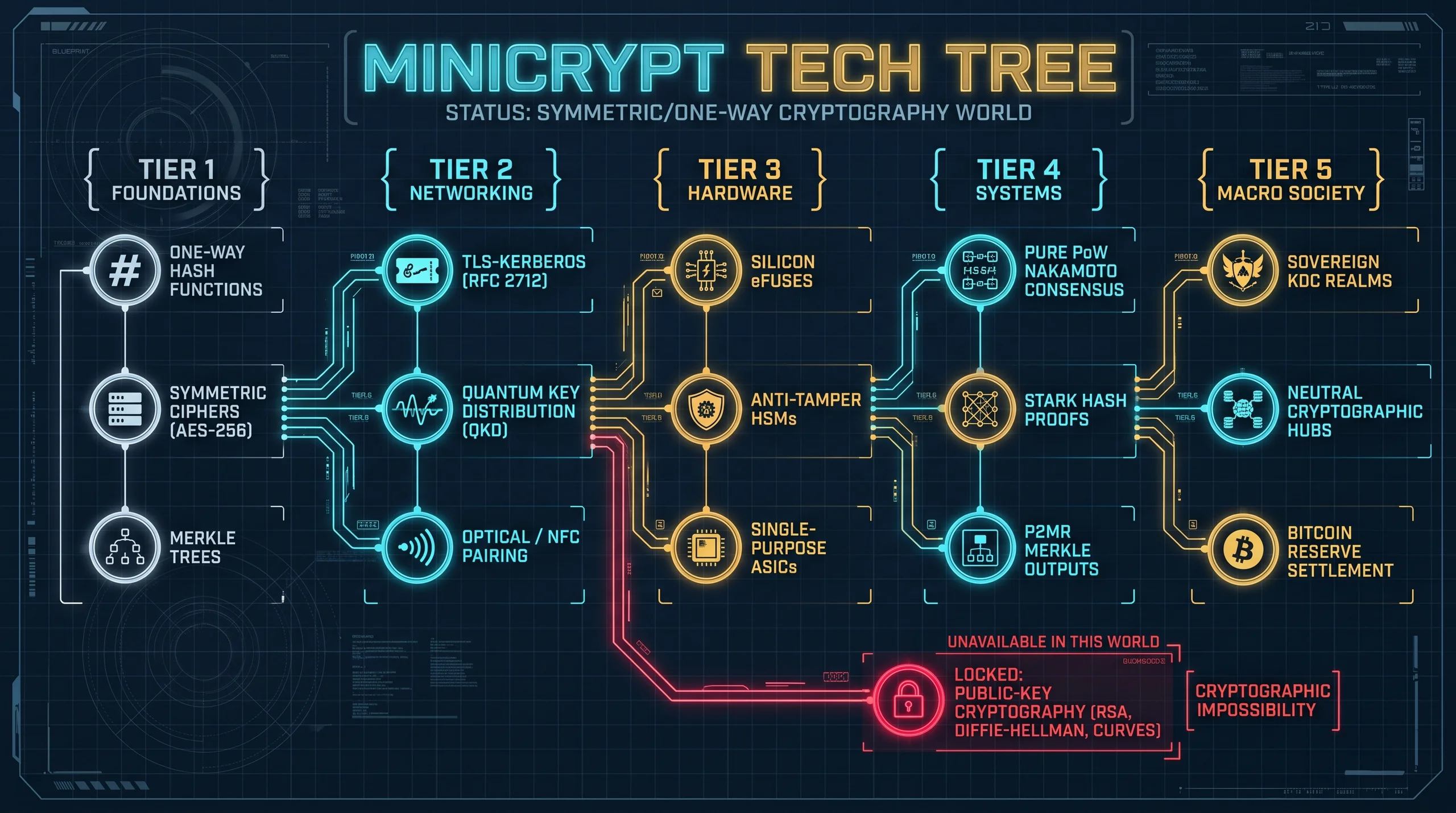
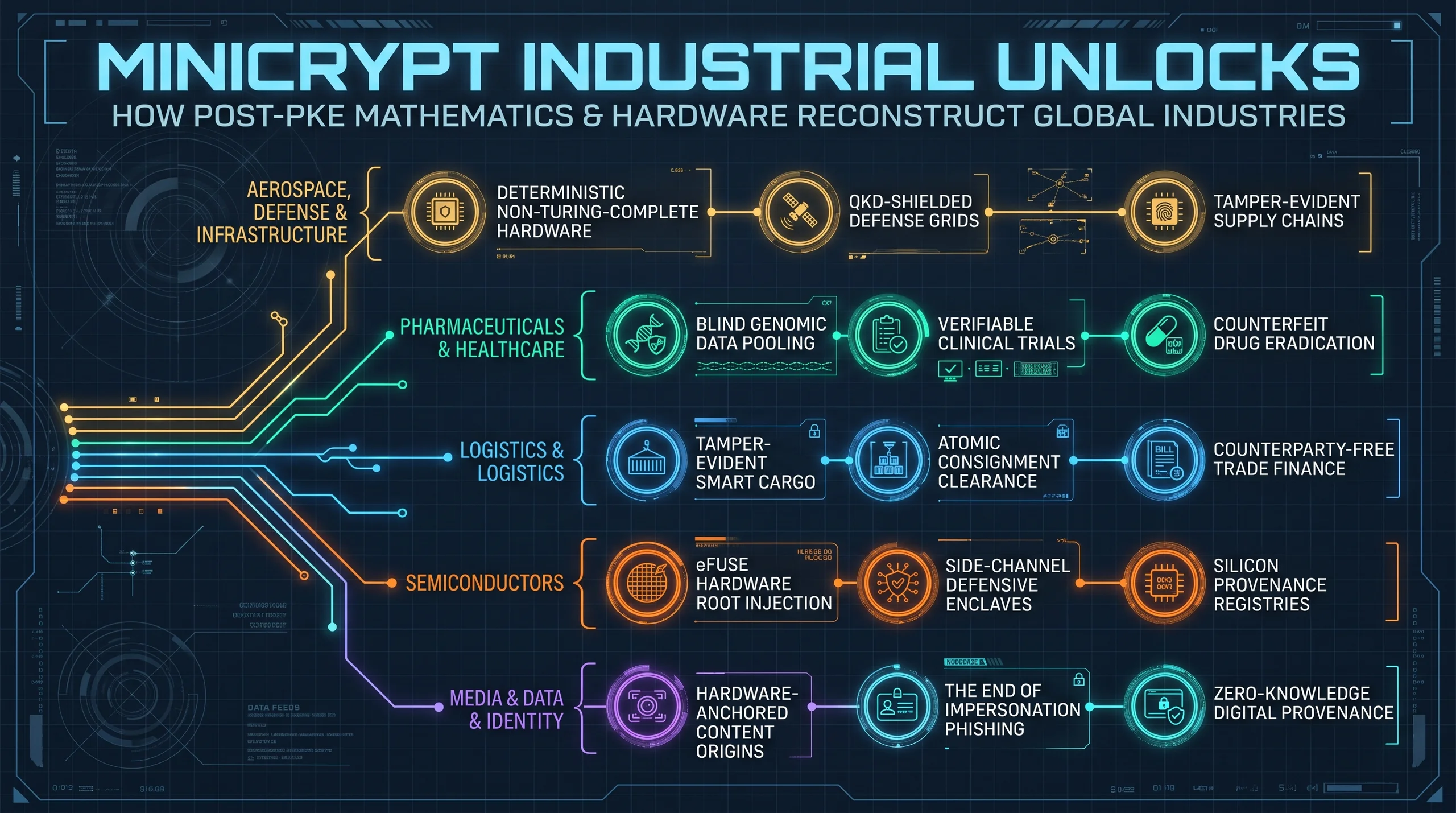
What stayed with me after the finale was Richard’s decision. It is easy to imagine a lab arguing that a breakthrough is too valuable to stop. It is much harder to decide who gets to accept the privacy costs on everyone else’s behalf.
Whether that future arrives remains unresolved. This thought experiment reveals how much freedom comes from being able to establish trust without asking a gatekeeper for permission.
If preserving that freedom became difficult, would we build alternatives people could actually use? Or would we accept the default, and let someone else hold the keys?